Shakespeare’s Sonnets: The Complete 46-Sonnet Reader
Every sonnet in the reading list, with an argument, key lines, and an exam angle
- Author / Source
- William Shakespeare (1564–1616)
- Period
- Elizabethan/Jacobean England; Sonnets published 1609
- Form & Meter
- Shakespearean sonnet sequence; fourteen-line poems in iambic pentameter
- Core Conflict
- How do desire, time, rivalry, and self-deception shape the stories the sonnets tell about love?
I. The Executive Dispatch (TL;DR)
- This reader covers all forty-six sonnets on the ENGL-200A list, in numerical order, from Sonnet 1 to Sonnet 154.
- Each entry gives you the argument, the key lines, and the critical subtext so you can move from comprehension to analysis quickly.
- The sequence is not a single story. It moves through procreation, rivalry, absence, constancy, desire, disgust, and self-deception.
- Read for the turn. The volta — at line 9 or in the couplet — is often where the poem’s real argument appears.
- The one-line exam takeaway: the sonnets are not confessions; they are rhetorical performances that test what love, time, and poetry can do.
II. How to Use This Reader
The four thematic guides on the site give the sequence its context:
- Procreation, Time, and the Fair Youth — Sonnets 1, 2, 12, 15, 16, 18, 19, 20, 23, 29, 30.
- Rivalry, Betrayal, and the Rival Poet — Sonnets 33, 35, 36, 55, 60, 64, 65, 71, 73, 74, 80, 87.
- Absence, Constancy, and the Problem of Love — Sonnets 93, 94, 97, 98, 105, 106, 109, 110, 116, 117.
- Desire, Disgust, and the Dark Lady — Sonnets 127, 128, 129, 130, 135, 136, 138, 143, 144, 146, 147, 153, 154.
This page gathers every sonnet from those guides into one continuous reference. Use it when you need to check a single poem, revise a cluster, or find a quotation quickly.
For each sonnet, the pattern is:
- The Argument — what the poem is doing.
- Key Evidence — the lines to quote.
- The Subtext — the critical point that turns reading into an essay.
III. The Sonnets
Sonnet 1 — “From fairest creatures we desire increase”
The Argument. The poem opens with a general principle: beautiful creatures should reproduce so that beauty does not die. The Fair Youth, however, is “contracted to thine own bright eyes” and feeds his own flame. He is a “tender churl” who hoards his beauty instead of passing it on.
Key Evidence. “From fairest creatures we desire increase, / That thereby beauty’s rose might never die” (1.1–2). The couplet turns the youth into a “glutton” who eats “the world’s due” (1.13–14).
The Subtext. The sonnet establishes the sequence’s central analogy between biological and poetic generation. It also introduces the youth’s self-love, which the later sonnets will try to redirect.
Sonnet 2 — “When forty winters shall besiege thy brow”
The Argument. The poem imagines the youth grown old, his beauty “a tatter’d weed.” The only answer to age is a child who can “sum my count” and make his father’s old age meaningful.
Key Evidence. “When forty winters shall besiege thy brow, / And dig deep trenches in thy beauty’s field” (2.1–2). The child is imagined saying, “This fair child of mine / Shall sum my count, and make my old excuse” (2.10–11).
The Subtext. The military metaphor turns time into a siege. Reproduction becomes a form of accounting, a way of balancing the books against death.
Sonnet 12 — “When I do count the clock that tells the time”
The Argument. The speaker catalogues images of decay: nightfall, withered violets, silvered hair, bare trees, and harvested grain. The conclusion is that nothing can defend against time except “breed.”
Key Evidence. “When I do count the clock that tells the time” (12.1) establishes the poem’s measured, ticking rhythm. “And nothing ’gainst Time’s scythe can make defence / Save breed” (12.13–14).
The Subtext. The sonnet is a memento mori with a reproductive solution. It is also one of the sequence’s clearest statements of the procreation argument.
Sonnet 15 — “When I consider everything that grows”
The Argument. The speaker thinks about the brevity of perfection and the theatre of the world. He sees the Fair Youth “most rich in youth” and declares war on Time: as Time takes away, the poet will “engraft” the youth anew.
Key Evidence. “When I consider everything that grows / Holds in perfection but a little moment” (15.1–2). “And all in war with Time for love of you, / As he takes from you, I engraft you new” (15.13–14).
The Subtext. The poem shifts the means of preservation from children to verse. The horticultural metaphor of “engrafting” makes the poem itself a kind of graft, a way of keeping the youth alive in a new stock.
Sonnet 16 — “But wherefore do not you a mightier way”
The Argument. The speaker asks why the youth does not make war on Time more forcefully. His “barren rhyme” is weaker than the “lines of life” that children would produce. The couplet turns the argument: “To give away yourself, keeps yourself still.”
Key Evidence. “But wherefore do not you a mightier way / Make war upon this bloody tyrant, Time?” (16.1–2). “To give away yourself, keeps yourself still, / And you must live, drawn by your own sweet skill” (16.13–14).
The Subtext. The sonnet explicitly compares poetic and biological reproduction, and it seems to concede that children are better. The concession is also a rhetorical move: it makes the poem’s own claim to preserve the youth seem modest and therefore credible.
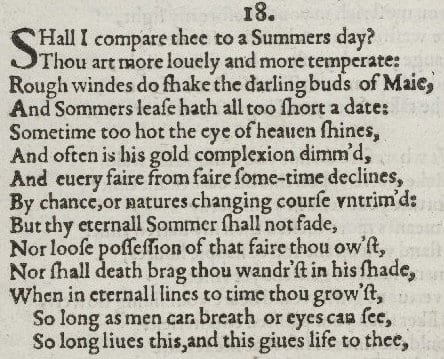
Sonnet 18 — “Shall I compare thee to a summer’s day?”
The Argument. The speaker begins with a conventional comparison, then outdoes it: the youth is “more lovely and more temperate.” Summer fades, but the youth’s “eternal summer” will not, because the poem will preserve him.
Key Evidence. “Shall I compare thee to a summer’s day? / Thou art more lovely and more temperate” (18.1–2). “So long as men can breathe, or eyes can see, / So long lives this, and this gives life to thee” (18.13–14).
The Subtext. The poem is a boast about poetry disguised as a compliment. Its immortality depends on the continued existence of readers — a condition it cannot guarantee. The couplet’s confidence is both moving and fragile.
Sonnet 19 — “Devouring Time, blunt thou the lion’s paws”
The Argument. The speaker addresses Time directly, granting it power over the natural world but forbidding it to touch the youth’s beauty. In the couplet, he defies Time: the youth will live young in his verse.
Key Evidence. “Devouring Time, blunt thou the lion’s paws” (19.1). “Yet do thy worst, old Time; despite thy wrong, / My love shall in my verse ever live young” (19.13–14).
The Subtext. The sonnet is a contest between two kinds of power: Time’s destruction and the poet’s representation. The poet’s defiance is heroic, but it depends on the poem surviving the very force it opposes.
Sonnet 20 — “A woman’s face with nature’s own hand painted”
The Argument. The speaker describes the Fair Youth as a “master mistress”: he has a woman’s face and heart, but not women’s “shifting change.” Nature made him a woman until she added “one thing” that defeats the speaker’s desire.
Key Evidence. “A woman’s face with nature’s own hand painted, / Hast thou, the master mistress of my passion” (20.1–2). “By adding one thing to my purpose nothing” (20.12).
The Subtext. The poem is a knot of gender and desire. It praises the youth for qualities coded as feminine while insisting on his maleness. The puns on “hue” and “thing” make the body a site of wordplay and ambiguity.
Sonnet 23 — “As an unperfect actor on the stage”
The Argument. The speaker compares himself to an inexperienced actor who forgets his part, or a wild animal weakened by its own rage. His love makes him unable to perform the “ceremony of love’s rite.” He asks the beloved to read his looks instead.
Key Evidence. “As an unperfect actor on the stage, / Who with his fear is put beside his part” (23.1–2). “O! learn to read what silent love hath writ: / To hear with eyes belongs to love’s fine wit” (23.13–14).
The Subtext. The sonnet turns silence into eloquence. It also makes reading a model of love: the beloved must interpret the speaker’s body as a text.
Sonnet 29 — “When in disgrace with fortune and men’s eyes”
The Argument. The speaker describes his isolation, envy, and self-loathing. Then he thinks of the beloved, and his state changes: like a lark rising at dawn, he sings hymns at heaven’s gate.
Key Evidence. “When in disgrace with fortune and men’s eyes / I all alone beweep my outcast state” (29.1–2). “For thy sweet love remember’d such wealth brings / That then I scorn to change my state with kings” (29.13–14).
The Subtext. The sonnet is a conversion narrative in miniature. The beloved’s love does not change the speaker’s external circumstances; it changes his relation to them.
Sonnet 30 — “When to the sessions of sweet silent thought”
The Argument. The speaker summons memories of past losses and grievances. The memory of the beloved interrupts the mourning and restores what was lost.
Key Evidence. “When to the sessions of sweet silent thought / I summon up remembrance of things past” (30.1–2). “But if the while I think on thee, dear friend, / All losses are restor’d and sorrows end” (30.13–14).
The Subtext. The legal metaphor (“sessions,” “summon,” “account”) turns memory into a courtroom. Love is the verdict that ends the case — or at least suspends it.
Sonnet 33 — “Full many a glorious morning have I seen”
The Argument. The speaker compares the beloved to a beautiful morning that is suddenly obscured by clouds. The sun was “but one hour mine”; the cloud has masked it. Yet the speaker refuses to disdain him, because even the sun can be stained.
Key Evidence. “Full many a glorious morning have I seen / Flatter the mountain tops with sovereign eye” (33.1–2). “Suns of the world may stain when heaven’s sun staineth” (33.14).
The Subtext. The sonnet naturalises betrayal: the beloved’s fault is like a cloud passing over the sun. The analogy makes the fault easier to forgive, but it also makes it inevitable.
Sonnet 35 — “No more be griev’d at that which thou hast done”
The Argument. The speaker tells the beloved to stop grieving over his fault. Roses have thorns, fountains have mud, and the sun is stained by eclipses. The speaker then admits that he is complicit: he excuses the beloved’s sin and becomes “an accessary” to it.
Key Evidence. “No more be griev’d at that which thou hast done: / Roses have thorns, and silver fountains mud” (35.1–2). “Such civil war is in my love and hate” (35.12).
The Subtext. The sonnet turns forgiveness into self-corruption. The speaker’s love makes him an advocate for the beloved against his own judgment.
Sonnet 36 — “Let me confess that we two must be twain”
The Argument. The speaker accepts that he and the beloved must be separated, even though their loves are one. He will bear the “blots” alone and will not publicly acknowledge the beloved, to spare him shame.
Key Evidence. “Let me confess that we two must be twain, / Although our undivided loves are one” (36.1–2). “I may not evermore acknowledge thee” (36.9).
The Subtext. The sonnet makes separation an act of love. It also makes love a secret, and secrecy gives the relationship a dangerous intimacy.
Sonnet 55 — “Not marble, nor the gilded monuments”
The Argument. The speaker claims that his “powerful rhyme” will outlive marble and gold. War and fire may destroy statues, but the beloved’s memory will survive in the poem.
Key Evidence. “Not marble, nor the gilded monuments / Of princes, shall outlive this powerful rhyme” (55.1–2). “You live in this, and dwell in lovers’ eyes” (55.14).
The Subtext. The poem is a monument that claims to be better than monuments. Its confidence is magnificent, but it depends on the poem being read — and on “lovers’ eyes” to keep it alive.
Sonnet 60 — “Like as the waves make towards the pebbled shore”
The Argument. The speaker compares human life to waves advancing on a shore. Time gives and takes, crowns and confounds. Yet the poem will stand, praising the beloved’s worth.
Key Evidence. “Like as the waves make towards the pebbled shore, / So do our minutes hasten to their end” (60.1–2). “And yet to times in hope, my verse shall stand” (60.13).
The Subtext. The wave simile is one of Shakespeare’s most perfect images of sequential time. The poem’s counter-claim is not that time stops, but that verse can endure within it.
Sonnet 64 — “When I have seen by Time’s fell hand defac’d”
The Argument. The speaker catalogues ruins: buried monuments, demolished towers, the ocean eating the shore. Ruin teaches him that Time will take his love away. The thought is a kind of death.
Key Evidence. “When I have seen by Time’s fell hand defac’d / The rich-proud cost of outworn buried age” (64.1–2). “That Time will come and take my love away” (64.12).
The Subtext. The sonnet is unusual because it does not offer a clear consolation. The poem ends in grief, not in a triumphant claim about verse.
Sonnet 65 — “Since brass, nor stone, nor earth, nor boundless sea”
The Argument. The speaker asks how beauty can survive when even brass, stone, earth, and sea are subject to mortality. The only answer is a “miracle”: that his love may “still shine bright” in black ink.
Key Evidence. “Since brass, nor stone, nor earth, nor boundless sea, / But sad mortality o’ersways their power” (65.1–2). “That in black ink my love may still shine bright” (65.14).
The Subtext. The couplet names the poem’s medium — black ink — as the source of its miracle. The modest materiality of ink contrasts with the grandeur of the claims.
Sonnet 71 — “No longer mourn for me when I am dead”
The Argument. The speaker asks the beloved not to mourn for him after he dies. He would rather be forgotten than cause pain. The final couplet fears the world’s mockery.
Key Evidence. “No longer mourn for me when I am dead / Than you shall hear the surly sullen bell” (71.1–2). “Lest the wise world should look into your moan, / And mock you with me after I am gone” (71.13–14).
The Subtext. The poem’s request to be forgotten is also a demand to be remembered. It stages the speaker’s death as a way of testing the beloved’s love.
Sonnet 73 — “That time of year thou mayst in me behold”
The Argument. The speaker compares himself to late autumn, twilight, and a dying fire. Each image makes his age visible to the beloved, and each image intensifies the beloved’s love.
Key Evidence. “That time of year thou mayst in me behold / When yellow leaves, or none, or few, do hang” (73.1–2). “To love that well, which thou must leave ere long” (73.14).
The Subtext. The sonnet turns decay into an argument for love. The beloved should love the speaker more because he will soon be lost.
Sonnet 74 — “But be contented: when that fell arrest”
The Argument. The speaker imagines his death and distinguishes between body and spirit. The earth will have his body; the beloved will have his spirit, which remains in the poem.
Key Evidence. “But be contented: when that fell arrest / Without all bail shall carry me away” (74.1–2). “The earth can have but earth, which is his due; / My spirit is thine, the better part of me” (74.7–8).
The Subtext. The sonnet uses legal and financial language (“arrest,” “bail,” “interest”) to make death a transaction. Love is what survives the settlement.
Sonnet 80 — “O how I faint when I of you do write”
The Argument. The speaker compares himself to a “saucy bark” and the rival poet to a great ship. The rival’s verse is grander, but the speaker’s love is his own. If he is wrecked, it will be because his love has decayed.
Key Evidence. “O how I faint when I of you do write, / Knowing a better spirit doth use your name” (80.1–2). “My love was my decay” (80.14).
The Subtext. The sonnet is a defense of the speaker’s lesser art. It turns inferiority into a proof of sincerity.
Sonnet 87 — “Farewell! thou art too dear for my possessing”
The Argument. The speaker releases the beloved, saying that he is “too dear” to possess. The language of charters, bonds, and patents makes the relationship a legal transaction. The beloved’s worth is beyond the speaker’s deserving.
Key Evidence. “Farewell! thou art too dear for my possessing, / And like enough thou know’st thy estimate” (87.1–2). “Thus have I had thee, as a dream doth flatter, / In sleep a king, but waking no such matter” (87.13–14).
The Subtext. The sonnet turns farewell into a financial settlement. Its sadness lies in the gap between the dream of possession and the waking recognition of loss.
Sonnet 93 — “So shall I live, supposing thou art true”
The Argument. The speaker compares himself to a deceived husband. The beloved’s face is so lovely that it cannot reveal a false heart. He must live in uncertainty, trusting a beauty that may be a lie.
Key Evidence. “So shall I live, supposing thou art true, / Like a deceived husband” (93.1–2). “How like Eve’s apple doth thy beauty grow, / If thy sweet virtue answer not thy show!” (93.13–14).
The Subtext. The comparison to Eve’s apple makes the beloved’s beauty both tempting and dangerous. The poem’s torment is epistemic: the speaker cannot know what he most needs to know.
Sonnet 94 — “They that have power to hurt, and will do none”
The Argument. The speaker describes people who have the power to harm but choose not to. They are “unmoved, cold, and to temptation slow,” and they inherit heaven’s graces. But the final couplet warns that “sweetest things turn sourest by their deeds.”
Key Evidence. “They that have power to hurt, and will do none” (94.1). “Lilies that fester, smell far worse than weeds” (94.14).
The Subtext. The sonnet is ambiguous: is the cold, self-possessed person admirable or dangerous? The closing image suggests that beauty without action can become corruption.
Sonnet 97 — “How like a winter hath my absence been”
The Argument. The speaker’s absence from the beloved makes the year feel like winter, even when it is summer or autumn. The seasons’ abundance seems like “hope of orphans” because the beloved is not there.
Key Evidence. “How like a winter hath my absence been / From thee, the pleasure of the fleeting year!” (97.1–2). “For summer and his pleasures wait on thee, / And, thou away, the very birds are mute” (97.11–12).
The Subtext. The poem makes absence a form of seasonal disorder. The beloved is not just missed; he is the principle that makes the world intelligible.
Sonnet 98 — “From you have I been absent in the spring”
The Argument. The speaker was absent in spring, when April put “a spirit of youth in every thing.” Yet the flowers and birds seemed only “figures of delight, / Drawn after you.” Without the beloved, it still felt like winter.
Key Evidence. “From you have I been absent in the spring” (98.1). “They were but sweet, but figures of delight, / Drawn after you, you pattern of all those” (98.11–12).
The Subtext. The poem turns the beloved into a pattern or original, and the natural world into a copy. It is a compliment, but it also empties the world of independent value.
Sonnet 105 — “Let not my love be call’d idolatry”
The Argument. The speaker denies that his love is idolatry. His songs are all to “one, of one, still such, and ever so.” His love is constant, and his verse is confined to “one thing.” The couplet claims that “fair, kind, and true” have never before lived together in one person.
Key Evidence. “Let not my love be call’d idolatry, / Nor my beloved as an idol show” (105.1–2). “Fair, kind, and true, have often liv’d alone, / Which three till now, never kept seat in one” (105.13–14).
The Subtext. The poem defends love against the charge of idolatry by turning constancy into a kind of theology. The beloved becomes a trinity of qualities, and the speaker’s verse becomes a form of worship.
Sonnet 106 — “When in the chronicle of wasted time”
The Argument. The speaker reads old chronicles and blazons of past beauties. He realizes that the old poets were prophesying the Fair Youth’s beauty. They had “divining eyes” but not enough skill to praise him fully.
Key Evidence. “When in the chronicle of wasted time / I see descriptions of the fairest wights” (106.1–2). “So all their praises are but prophecies / Of this our time, all you prefiguring” (106.9–10).
The Subtext. The sonnet makes literary history serve the beloved. It also makes the speaker’s own praise a fulfillment of tradition, even as it claims that present poets lack “tongues to praise.”
Sonnet 109 — “O! never say that I was false of heart”
The Argument. The speaker denies that he was unfaithful. Absence may have seemed to cool his flame, but he could as easily leave himself as leave the beloved. He returns, bringing “water for my stain.”
Key Evidence. “O! never say that I was false of heart, / Though absence seem’d my flame to qualify” (109.1–2). “For nothing this wide universe I call, / Save thou, my rose, in it thou art my all” (109.13–14).
The Subtext. The poem turns the beloved into the speaker’s entire world. The language of return and cleansing suggests a ritual of forgiveness.
Sonnet 110 — “Alas! ’tis true, I have gone here and there”
The Argument. The speaker confesses that he has wandered and made himself a “motley to the view.” But those “blenches” gave his heart another youth and proved the beloved his “best of love.” He vows to be faithful.
Key Evidence. “Alas! ’tis true, I have gone here and there, / And made my self a motley to the view” (110.1–2). “These blenches gave my heart another youth, / And worse essays prov’d thee my best of love” (110.7–8).
The Subtext. The sonnet turns infidelity into a proof of the beloved’s superiority. The confession is also a strategy of seduction.
Sonnet 116 — “Let me not to the marriage of true minds”
The Argument. The speaker defines love as a union that does not admit impediments. It does not alter when it finds alteration, nor bend when the beloved removes. It is an “ever-fixed mark” and a star. Time may take rosy lips and cheeks, but love bears it out to the edge of doom.
Key Evidence. “Let me not to the marriage of true minds / Admit impediments” (116.1–2). “Love’s not Time’s fool, though rosy lips and cheeks / Within his bending sickle’s compass come” (116.9–10).
The Subtext. The poem is a definition, a vow, and a challenge. Its confidence is absolute, but its final couplet makes the definition a wager: if it is wrong, the speaker has never written and no one has ever loved.
Sonnet 117 — “Accuse me thus: that I have scanted all”
The Argument. The speaker invites accusation: he has been absent, unfaithful, and careless. He has “hoisted sail to all the winds.” But he appeals to the beloved’s constancy, asking him not to shoot in “waken’d hate.”
Key Evidence. “Accuse me thus: that I have scanted all, / Wherein I should your great deserts repay” (117.1–2). “Since my appeal says I did strive to prove / The constancy and virtue of your love” (117.13–14).
The Subtext. The sonnet turns confession into a legal appeal. The speaker’s faults become evidence of the beloved’s virtue.
Sonnet 127 — “In the old age black was not counted fair”
The Argument. The speaker says that black was once not considered beautiful, but now black is “beauty’s successive heir.” The mistress’s eyes are raven black, and her mourning looks becoming. Every tongue says beauty should look so.
Key Evidence. “In the old age black was not counted fair, / Or if it were, it bore not beauty’s name” (127.1–2). “Therefore my mistress’ eyes are raven black” (127.9).
The Subtext. The poem makes black beauty a challenge to convention. It also associates the mistress’s beauty with mourning and false esteem.
Sonnet 128 — “How oft when thou, my music, music play’st”
The Argument. The speaker watches the mistress play the virginal. He envies the “jacks” that leap to kiss her hand, while his own lips must stand blushing by. He asks for her fingers for the keys and her lips for him.
Key Evidence. “How oft when thou, my music, music play’st, / Upon that blessed wood whose motion sounds” (128.1–2). “Give them thy fingers, me thy lips to kiss” (128.14).
The Subtext. The poem turns musical performance into erotic rivalry. The instrument becomes a rival body, and the speaker’s desire is both playful and possessive.
Sonnet 129 — “The expense of spirit in a waste of shame”
The Argument. The speaker defines lust as an expense of spirit and a waste of shame. Before the act, lust is murderous and full of blame; after it, it is despised. The world knows this, yet no one knows how to avoid it.
Key Evidence. “The expense of spirit in a waste of shame / Is lust in action” (129.1–2). “All this the world well knows; yet none knows well / To shun the heaven that leads men to this hell” (129.13–14).
The Subtext. The poem is a paradox: lust is both heaven and hell, pursuit and punishment. Its final couplet admits that knowledge is not cure.
Sonnet 130 — “My mistress’ eyes are nothing like the sun”
The Argument. The speaker denies every conventional comparison: coral is redder than her lips, snow is whiter than her breasts, roses are not in her cheeks, and her breath is not perfume. Yet he thinks his love as rare as any woman falsely praised.
Key Evidence. “My mistress’ eyes are nothing like the sun; / Coral is far more red, than her lips red” (130.1–2). “And yet by heaven, I think my love as rare, / As any she belied with false compare” (130.13–14).
The Subtext. The poem is anti-blazon, not anti-love. It rejects the rhetoric of idealisation while making a new claim for the beloved’s value.
Sonnet 135 — “Whoever hath her wish, thou hast thy ‘Will’”
The Argument. The speaker puns on “Will” as his name, desire, and sexual will. He asks the mistress to accept his will along with all the others. The sea receives rain and still grows; she should add his will to her abundance.
Key Evidence. “Whoever hath her wish, thou hast thy ‘Will,’ / And ‘Will’ to boot, and ‘Will’ in over-plus” (135.1–2). “Think all but one, and me in that one ‘Will’” (135.14).
The Subtext. The poem is a comic performance of sexual demande. The puns make desire both literal and linguistic.
Sonnet 136 — “If thy soul check thee that I come so near”
The Argument. The speaker tells the mistress to swear to her soul that he is her “Will.” Since “will” is admitted there, she should fulfill his love-suit. He asks to be counted as one among many, or as nothing, as long as she loves his name.
Key Evidence. “If thy soul check thee that I come so near, / Swear to thy blind soul that I was thy ‘Will’” (136.1–2). “Make but my name thy love, and love that still, / And then thou lov’st me for my name is ‘Will’” (136.13–14).
The Subtext. The poem turns identity into a pun. The speaker’s name becomes both his self and his desire, and love becomes a matter of accepting a word.
Sonnet 138 — “When my love swears that she is made of truth”
The Argument. The speaker believes his mistress even though he knows she lies, because he wants her to think him young and naive. She knows he is old; he knows she lies. Both suppress the truth, and their love is sustained by flattery.
Key Evidence. “When my love swears that she is made of truth, / I do believe her though I know she lies” (138.1–2). “Therefore I lie with her, and she with me, / And in our faults by lies we flatter’d be” (138.13–14).
The Subtext. The sonnet makes self-deception mutual. The pun on “lie” (to speak falsely and to sleep with) turns the poem’s ethical problem into a sexual joke.
Sonnet 143 — “Lo, as a careful housewife runs to catch”
The Argument. The speaker compares the mistress to a housewife who abandons her crying baby to chase a runaway chicken. He is the baby, chasing her while she pursues something else. If she catches her “Will,” he asks her to turn back and kiss him.
Key Evidence. “Lo, as a careful housewife runs to catch / One of her feather’d creatures broke away” (143.1–2). “So will I pray that thou mayst have thy ‘Will,’ / If thou turn back and my loud crying still” (143.13–14).
The Subtext. The simile is comic and humiliating. The speaker casts himself as an infant, dependent on a woman who is pursuing someone else.
Sonnet 144 — “Two loves I have of comfort and despair”
The Argument. The speaker has two loves: a “better angel” who is a fair man and a “worser spirit” who is a dark woman. The woman tempts the man away, and the speaker fears that his good angel may become a fiend.
Key Evidence. “Two loves I have of comfort and despair, / Which like two spirits do suggest me still” (144.1–2). “The better angel is a man right fair, / The worser spirit a woman colour’d ill” (144.3–4).
The Subtext. The sonnet clarifies the sequence’s two loves as a moral allegory. The speaker’s jealousy is both sexual and spiritual.
Sonnet 146 — “Poor soul, the centre of my sinful earth”
The Argument. The speaker addresses his soul, asking why it spends so much on the body’s outward display when the body is destined for worms. The soul should live on the body’s loss and buy “terms divine” by selling hours of dross.
Key Evidence. “Poor soul, the centre of my sinful earth, / My sinful earth these rebel powers array” (146.1–2). “So shalt thou feed on Death, that feeds on men, / And Death once dead, there’s no more dying then” (146.13–14).
The Subtext. The poem is a Christian meditation on mortality and the soul’s priority. It turns the sequence’s sexual obsession into a dialogue between body and soul.
Sonnet 147 — “My love is as a fever longing still”
The Argument. The speaker’s love is a fever that feeds on what preserves the disease. Reason, the physician, has left him because he will not follow its prescriptions. He is “past cure” and “frantic-mad,” swearing that the mistress is fair though she is “as black as hell.”
Key Evidence. “My love is as a fever longing still, / For that which longer nurseth the disease” (147.1–2). “For I have sworn thee fair, and thought thee bright, / Who art as black as hell, as dark as night” (147.13–14).
The Subtext. The poem turns desire into pathology. The speaker knows his love is destructive, but knowledge does not free him.
Sonnet 153 — “Cupid laid by his brand and fell asleep”
The Argument. Cupid falls asleep and a nymph steals his brand, quenching it in a cold fountain. The water becomes a healing bath. The speaker, sick with love, goes to the bath but finds no cure; the only cure lies in the mistress’s eyes.
Key Evidence. “Cupid laid by his brand and fell asleep: / A maid of Dian’s this advantage found” (153.1–2). “But found no cure, the bath for my help lies / Where Cupid got new fire; my mistress’ eyes” (153.13–14).
The Subtext. The poem is an allegory of desire and its remedies. The bath can cool ordinary love, but the mistress’s eyes reignite it.
Sonnet 154 — “The little Love-god lying once asleep”
The Argument. The same story is retold: Cupid sleeps, a nymph steals his brand, and the brand quenches in a well, making a healing bath. The speaker comes for cure but proves that “Love’s fire heats water, water cools not love.”
Key Evidence. “The little Love-god lying once asleep, / Laid by his side his heart-inflaming brand” (154.1–2). “Love’s fire heats water, water cools not love” (154.14).
The Subtext. The final sonnet ends with a paradox: the cure for love is impossible. The sequence closes on desire’s resistance to remedy.
IV. Exam & Essay Sparkplugs
1. “The Fair Youth sonnets are about poetry, not love.” Discuss.
Winning Thesis Blueprint. The sequence begins by urging reproduction but increasingly makes poetry the means of preservation. The youth becomes an occasion for the poet’s self-fashioning, even as the poems claim to serve him.
Supporting points.
- The shift from the procreation sonnets to Sonnets 15–19.
- The competition between “lines of life” and “eternal lines.”
- The couplets’ boasts about verse.
2. “The Dark Lady sonnets are a comedy of self-deception.” Examine.
Winning Thesis Blueprint. Sonnets 135–138 use puns, repetition, and mutual lying to make desire a comic performance. The comedy does not cancel the pain; it exposes the fictions that make desire bearable.
Supporting points.
- The ‘Will’ puns.
- The mutual deception of Sonnet 138.
- The self-mockery of Sonnet 143.
3. “Sonnet 116 is a statement of faith, not a description of experience.” Discuss.
Winning Thesis Blueprint. Sonnet 116 defines love in absolute terms, but its confidence is rhetorical and its surrounding poems are full of absence and betrayal. The poem is a vow against experience, not a report of it.
Supporting points.
- The definitional structure of the opening.
- The images of the star and the ever-fixed mark.
- The wager of the final couplet.
V. Further Reading
Shakespeare, Shake-speares Sonnets (1609); the four thematic Study Herald sonnet guides; the course edition and annotations assigned in ENGL-200A.