The Verb Is the Argument: A Working Guide to Analysis Verbs
From ‘shows’ to ‘subverts’ — choosing the verb that says what the evidence actually does
- Desk
- The Study Herald Style Desk
- Context
- Contemporary academic writing, from close reading to empirical argument
- Method
- Analytical and reporting verbs; claim, evidence, and warrant
- Core Problem
- The verb that names what the evidence does versus the verb that merely raises the volume.
I. The Executive Dispatch (TL;DR)
- The verb is where analysis happens. “The poem uses imagery” describes. “The imagery unsettles the poem’s consoling close” argues. The difference is not vocabulary; it is the claim.
- Match the verb to the evidence. A single quotation can support suggests; it rarely supports proves. A sustained pattern can support establishes.
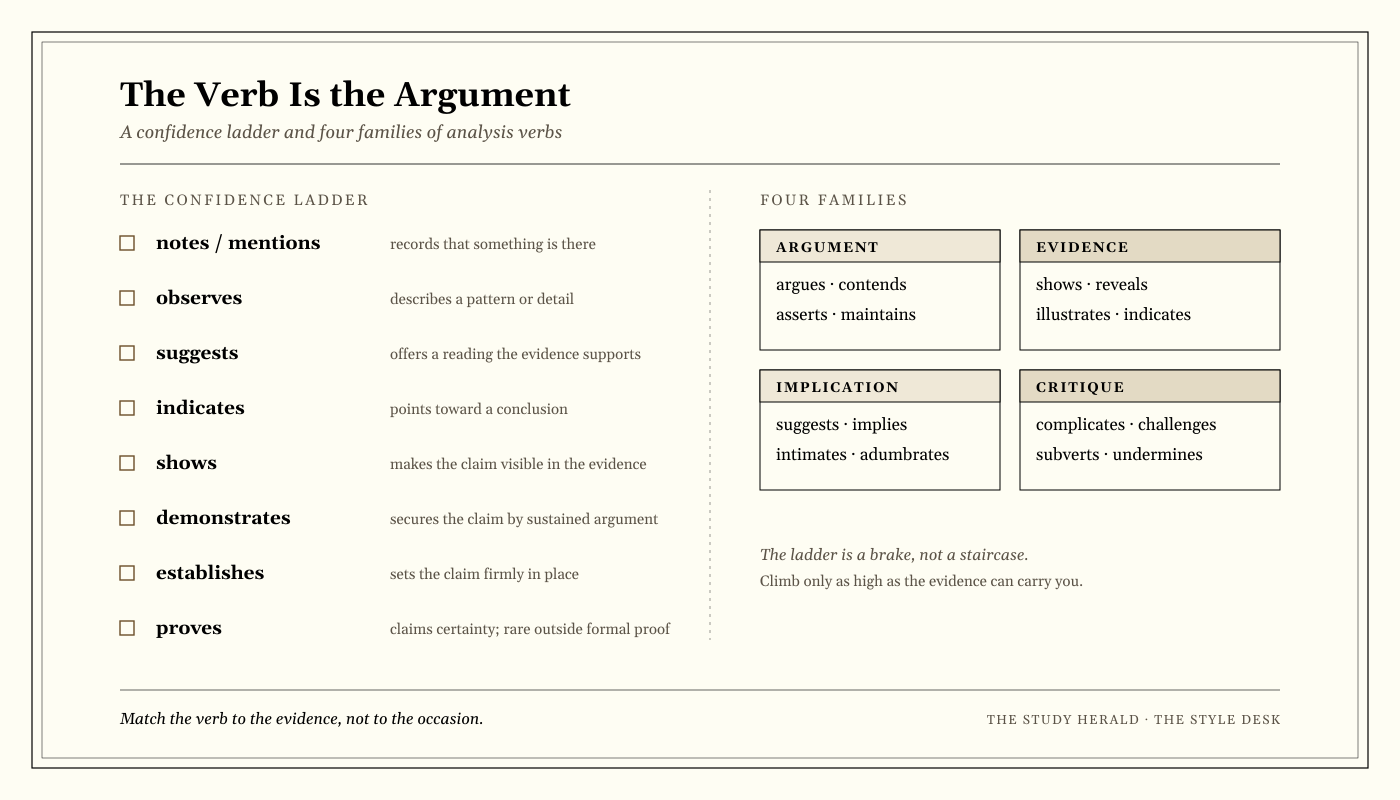
- Learn the confidence ladder: notes → observes → suggests → indicates → shows → demonstrates → establishes. Climb only as high as the evidence can carry you.
- Imply and infer point in opposite directions. The text implies; the reader infers. Do not write “the reader implies”.
- Choose the agent deliberately. The author, the narrator, the text, the structure, and the reader are not interchangeable, and each carries a different claim about intention.
- The one-line takeaway: if you cannot defend the verb in the next sentence, it is too strong.
II. The Backstory: Why the Verb Carries the Argument
From description to claim
Most weak essay sentences are not grammatically wrong. They are analytically empty. “The author uses repetition” is a true sentence about almost every text ever written, which is why it says almost nothing. “The repetition forces the reader to relive the speaker’s hesitation” is a claim: it names a mechanism, an effect, and a reader.
The verb is the hinge between evidence and interpretation. A quotation by itself is an object; a verb tells the reader what that object is doing in your argument. Change the verb and you change the claim. The ending suggests resignation and the ending enacts resignation are not two ways of saying the same thing: the first says a meaning is available, the second says the form itself performs it.
The “shows” problem
Shows is the default analysis verb, and it is not a sin. It is a promissory note. “The final scene shows Lear carrying Cordelia’s body” promises that the scene makes something visible, and the next sentence must explain how and to what end. When the explanation never arrives, shows becomes a way of gesturing at analysis without doing it.
The fix is not to ban shows or to replace it with a longer verb. The fix is to ask what kind of showing is happening. Is the evidence illustrating a pattern, revealing something hidden, indicating a direction, or demonstrating a claim by argument? Each of those is a different analytical move, and each has a verb that names it.
The intentional fallacy, briefly
In 1946, W. K. Wimsatt and Monroe Beardsley published “The Intentional Fallacy,” arguing that an author’s intention is not the same as a work’s meaning and cannot by itself settle an interpretation. The essay helped make “the text suggests” a normal academic construction. It also created a new problem: “the text” is a metaphor. A text does not intend, argue, or subvert in the way a person does.
That does not make the metaphor unusable. It makes it a claim you have to support. If you write “the novel argues,” you should be able to point to the passage where the argument is made and explain how. If you write “the author argues,” you are making a claim about intention and should be prepared to defend it. The safest habit is consistency: choose an agent and stay with it, rather than sliding between author, text, and narrator whenever the sentence needs a subject.
The confidence ladder
Analysis verbs differ in strength and in kind. The ladder below is a rough scale, not a law. Its purpose is to stop you from using a verb that claims more than the evidence can carry.
| Rung | Verbs | What it claims | Typical evidence |
|---|---|---|---|
| Notes / mentions | notes, mentions, records | The text includes it | The existence of a passage |
| Observes / describes | observes, describes, depicts | The text represents it in a particular way | A pattern of imagery, detail, or wording |
| Suggests / implies | suggests, implies, intimates | A meaning is available but not stated | Connotation, omission, structure |
| Indicates | indicates, points to | The evidence points in a direction | A recurrent pattern |
| Shows / illustrates | shows, illustrates, reveals | The evidence makes the claim visible | Close reading of a passage or example |
| Demonstrates / establishes | demonstrates, establishes | The claim is secured by sustained argument | Multiple pieces of evidence, reasoned analysis |
| Proves | proves | The claim is certain | Rare outside formal proof |
Most student essays live between suggests and shows. That is not a weakness. It is where most literary and historical evidence actually operates. The problem begins when a writer reaches for proves because suggests feels modest. Modesty is not a flaw in an argument; overclaiming is.
III. How to Choose a Verb
The four questions
| Question | What it decides |
|---|---|
| What is the evidence doing? | Whether the verb should describe, imply, reveal, complicate, or compare. |
| How strong is the claim? | Which rung of the confidence ladder the verb should occupy. |
| Who or what is the agent? | Whether the sentence attributes the action to the author, narrator, text, structure, or reader. |
| What is the warrant? | What licenses the move from the evidence to the claim. |
The fourth question is the one students skip. A warrant is the assumption that connects evidence to interpretation. If you say a recurring image of clocks suggests the novel’s fear of mortality, the warrant is that repeated images carry thematic weight — a reasonable assumption in literary criticism, but still an assumption you may need to make explicit. If you say the clocks prove it, the warrant has to be much stronger than a pattern.
Agent discipline
- The author implies intention. Use it when you are discussing a stated argument, a preface, a known position, or a deliberate choice you can evidence.
- The narrator distinguishes the teller from the author. Essential in fiction, where the narrator’s views may be ironised.
- The text implies a reading available to any careful reader. It is the safest default in close reading, provided you do not ask the text to do things only a person can do.
- The speaker is useful in poetry and drama, where the voice is not the poet.
- The reader implies an effect. Use it sparingly and with evidence: “the reader” is not a universal category, and different readers respond differently.
- The structure can carry an argument — chronology, chapter breaks, rhyme scheme — but only if you show how.
Syntax and transitivity
A verb’s grammar is part of its meaning. These are the errors examiners notice most.
- Imply / infer. The text implies; the reader infers. The direction is from text to meaning, then from meaning to reader.
- Suggest. Suggest that + clause, or suggest + gerund. Never “suggest me” or “suggest to do”.
- Argue. Argue that, argue for, argue against. You can argue a case, but you cannot argue a person.
- Contend. Contend that. Contend with means to struggle against, which is a different verb.
- Qualify. To qualify a claim is to limit it. To qualify as something is to meet a standard. The two uses are unrelated.
- Contrast. Contrasts with is intransitive; contrasts A with B is transitive. Do not write “contrasts to”.
- Juxtapose. Juxtapose A with B, or juxtaposes A and B.
- Parallel. As a verb it is transitive: the plot parallels the subplot. As an adjective it takes to: parallel to.
- Gesture toward. Gestures toward an idea; gestures at is more physical. The preposition changes the metaphor.
- Impinge. Impinge on or upon. It does not take a direct object.
Strong verbs, strong claims
A strong verb is not automatically a strong argument. Subverts is more forceful than qualifies, but if the evidence only supports qualification, subverts is a false claim dressed in a confident suit. Precision comes first; force is what precision earns. The best sentence often uses a modest verb and a precise mechanism: the final couplet qualifies the poem’s earlier confidence by turning permanence into a condition of print. That is stronger than the couplet subverts temporality, because it says how.
A worked revision
Start with the flat sentence:
Shakespeare uses imagery to show that love is temporary.
Now revise the verb and watch the claim change:
- Describes: The sonnet compares the beloved to a summer’s day.
- Suggests: The comparison suggests that the beloved is more moderate and more enduring than the season.
- Complicates: The final couplet complicates the comparison by locating the beloved’s permanence in the poem rather than in the person.
- Qualifies: The poem qualifies its own praise: the beloved will endure only as long as the lines are read.
Each version uses a different verb because it makes a different claim. None of them needs subverts. The verb should follow the thought, not decorate it.
IV. The Core Lexicon: Thirty-Six Verbs in Six Families
The entries below are grouped by the analytical move they name. Each gives a working definition, a model sentence, and the usage note that matters most. The model sentences are deliberately ordinary; the point is the verb, not the scenery.
Argument and assertion
Argues
Verb. Makes a case for a position, with reasons. In academic prose, a text can argue by implication as well as by explicit statement.
The essay argues that nostalgia is a form of forgetting.
Use argues when you can reconstruct the reasons. If the text only states a position without defending it, asserts is more accurate.
Asserts
Verb. States confidently, often without argument. Asserts can be neutral, but it often carries a hint of criticism: assertion without proof.
The preface asserts the book’s neutrality without defending it.
Use it when the confidence of the statement is itself worth noticing.
Claims
Verb. Puts forward as true. In academic writing, claims that often signals distance or scepticism.
The report claims that the policy reduced inequality, but its data stop in 2019.
Use claims when you intend to evaluate the claim. For neutral reporting, states or argues may be fairer.
Contends
Verb. Argues in opposition or under pressure; holds a claim against resistance.
The historian contends that the treaty was less a settlement than a pause.
Stronger and more combative than argues. Use it when the position is contested.
Maintains
Verb. Holds a position steadily, often against objection.
The author maintains that the distinction is stable across all four texts.
It implies persistence, which makes it useful for a position developed over a whole work. It is weaker than contends in combativeness but stronger in consistency.
Posits
Verb. Puts forward as a premise or hypothesis, often at the start of an argument.
The theory posits a causal link between literacy and state formation.
Formal and slightly technical. Use it for starting assumptions, not conclusions.
Evidence and demonstration
Demonstrates
Verb. Shows by reasoning or evidence; stronger than shows, often implying a structured proof.
The experiment demonstrates that the enzyme is inhibited at high substrate concentrations.
In science, demonstrates carries real weight. In literary criticism, use it only when the analysis is sustained enough to deserve the word.
Establishes
Verb. Secures a claim, often for the purposes of an argument; sets something firmly in place.
The first chapter establishes the novel’s distrust of genealogical inheritance.
It also means “to found” — to establish a colony, an institution — so check the context. In argument, establishes is one of the strongest verbs available short of proves.
Shows
Verb. The broad, safe verb: the evidence makes the claim visible.
The final scene shows Lear carrying Cordelia’s body.
It is not a sin, but it is a promissory note. The next sentence should say how the scene shows what you claim. If you cannot, the verb is doing work the analysis has not done.
Illustrates
Verb. Serves as an example of a larger claim; it does not prove the claim.
The anecdote illustrates the pattern without explaining its cause.
Use it when the evidence is exemplary rather than exhaustive. Illustrates is honest about its limits, which makes it a good verb for examples.
Reveals
Verb. Makes visible something that was hidden or overlooked; implies depth and a reading beneath the surface.
The dedication reveals a patron’s anxiety about authorship.
Stronger than shows because it claims concealment and disclosure. Use it when you can identify the surface that concealed the meaning.
Indicates
Verb. Points toward a conclusion without fully securing it.
The pattern of omissions indicates a deliberate editorial policy.
Weaker than shows, stronger than suggests in some contexts, but less certain about mechanism. Good for evidence that points but does not prove.
Implication and suggestion
Suggests
Verb. Offers a possibility; a reading the evidence supports without compelling.
The silence suggests complicity, though the text never says so.
This is the workhorse of careful academic prose. It is not a coward’s verb; it is a precise claim about the strength of the evidence. If the evidence is strong, shows or indicates may be better. If it is suggestive, suggests is exactly right.
Implies
Verb. Means something without stating it; the meaning is carried by implication.
The repeated refusal to name the mother implies a deliberate erasure.
Remember the direction: the text implies; the reader infers. “The reader implies” is a category error.
Intimates
Verb. Hints at something delicately or indirectly; more literary and formal than suggests.
The closing line intimates that the marriage is already over.
Pronounced IN-ti-mates when it is a verb. Do not confuse it with the adjective intimate (close or private).
Insinuates
Verb. Suggests something indirectly, often with a negative or hostile edge. It also means to insert oneself into a position.
The review insinuates that the findings were selected to flatter the funder.
Use it when the implication is unflattering and deniable. It is stronger and more loaded than suggests.
Gestures toward
Verb phrase. Points loosely in the direction of an idea without fully developing it.
The final chapter gestures toward a theory of affect but does not build one.
Slightly informal and useful when the text is genuinely underdeveloped. It is an honest verb: it admits that the idea is not yet fully present.
Adumbrates
Verb. Outlines or foreshadows something faintly; suggests in advance.
The early description of the garden adumbrates the novel’s later violence.
Formal and rare. Use it when the text provides a shadow of what is to come, not a clear statement.
Complication and critique
Complicates
Verb. Introduces a factor that makes a simple claim inadequate. It does not mean “makes difficult”.
The second narrative complicates the first’s clean opposition between memory and truth.
A precise, powerful verb when you can name the complication. If you cannot say what the complication is, you are probably just saying the text is complex.
Challenges
Verb. Disputes or calls into question an established position.
The poem challenges the convention that grief should be silent.
The object should be a position, norm, or assumption, not a person. “Challenges the reader” is usually vague unless you say what the reader is being asked to reconsider.
Interrogates
Verb. Examines something closely and critically, as if under questioning.
The film interrogates the ethics of its own spectatorship.
Often overused. Use it when the text actively probes assumptions, not merely when it represents a problem.
Problematises
Verb. Makes something into a problem for analysis; shows that a concept is unstable or contested.
The novel problematises the boundary between testimony and fiction.
A strong theoretical verb. Do not use it for “raises a problem” in the ordinary sense; it means the text exposes the instability of a category.
Undermines
Verb. Weakens something gradually, often from within.
The narrator’s contradictions undermine his claim to objectivity.
Good for arguments, authority, and confidence. It usually requires evidence of internal tension rather than an external attack.
Subverts
Verb. Overturns or undermines the authority of an established system or expectation.
The ending subverts the marriage plot it has seemed to promise.
Stronger than undermines. Use it only when the text actively reverses or destabilises, not when it merely modifies. If the evidence supports modification, qualifies is the more accurate verb.
Construction and framing
Constructs
Verb. Builds meaning, identity, or reality through representation; a theoretical verb associated with constructivism.
The memoir constructs childhood as a lost language.
Do not use it for physical building in a literary essay. Use builds, describes, or depicts when that is what you mean. Constructs claims that the representation is doing constitutive work.
Frames
Verb. Sets the terms through which something is understood; controls the interpretive context.
The preface frames the letters as private documents, which makes their publication feel like a violation.
A useful verb for introductions, titles, epigraphs, and narrative perspective.
Foregrounds
Verb. Makes something prominent; brings it to the front of the composition or argument.
The opening shot foregrounds the empty chair.
The opposite move is usually marginalises or backgrounds. Say what the foregrounding displaces, not just what it highlights.
Naturalises
Verb. Presents something culturally constructed as natural, inevitable, or given.
The advertisement naturalises thinness as health.
Theoretical and evaluative. It requires evidence of the mechanism — repetition, framing, omission — not just a claim that something is socially constructed.
Reinforces
Verb. Strengthens an existing norm, pattern, or belief.
The repetition reinforces the association between silence and femininity.
Often used with stereotype, norm, hierarchy, and assumption. It is a verb of continuity, not creation.
Marginalises
Verb. Pushes a group, voice, or idea to the edges of power or attention.
The archive marginalises the accounts of seasonal workers.
Use it when you can identify the centre from which something is pushed. Otherwise the verb is doing rhetorical work without a mechanism.
Relation and comparison
Echoes
Verb. Repeats or recalls something with variation; suggests affinity without direct influence.
The final line echoes the sonnet’s opening, but the tone has changed.
It is a verb of resemblance, not proof of influence. If you mean influence, say so and evidence it.
Parallels
Verb. Runs alongside; resembles in structure or logic.
The two plots parallel each other without ever meeting.
As a verb it is transitive. As an adjective it takes to: parallel to. Do not write “parallels with”.
Contrasts
Verb. Differs from, or sets side by side to show difference.
The clean prose of the report contrasts with the mess of the testimony.
Contrasts with is intransitive; contrasts A with B is transitive.
Juxtaposes
Verb. Places side by side, often to produce meaning through comparison or shock.
The film juxtaposes archival footage with staged reenactment.
The effect is not automatic. Say what the juxtaposition does: does it expose a contradiction, create irony, or blur a distinction?
Extends
Verb. Develops an argument or method further.
The second study extends the model to non-Western contexts.
In criticism, extends a reading or a tradition. It is not a synonym for repeats or applies.
Qualifies
Verb. Limits or moderates a claim; adds a condition.
The conclusion qualifies the thesis without abandoning it.
Also means “meets a standard” — qualifies as a doctor — which is a different use. In argument, qualifies is often the honest alternative to subverts.
V. Reporting Verbs and the Wider Lexicon
Reporting verbs and stance
When you introduce a source, the verb tells the reader how to take it. The same claim can be reported as neutral, contested, conceded, or suspicious.
| Verb | Stance | Example |
|---|---|---|
| notes / observes | Neutral | The report notes that the sample was small. |
| states | Neutral, factual | The author states the policy’s aims. |
| argues / contends | Committed, interpretive | Smith argues that the policy failed. |
| suggests | Tentative | The data suggest a weaker effect. |
| concedes / acknowledges | Grants a point | The author concedes that the sample was limited. |
| warns | Cautionary | The historian warns against reading the treaty as a constitution. |
| claims | Distancing, sceptical | The company claims that the chemical is safe. |
| concludes | End of an argument | The study concludes that the effect is modest. |
Claims is not neutral. If you write “Smith claims”, you are signalling that you may not accept the claim. If you do accept it, argues or shows may be fairer. This is why reporting verbs are never merely decorative: they are the smallest possible summary of your judgement.
Verbs for the margin
The table below collects thirty more verbs that are useful in analysis but easy to misuse. Learn the ones you can imagine using; leave the rest.
| Verb | Type | Working definition |
|---|---|---|
| Bolsters | v. | Supports or strengthens. Evidence can bolster a case; it cannot bolster a person. |
| Circumscribes | v. | Limits the scope of; draws a boundary around. |
| Codifies | v. | Organises into a system or code; makes official. |
| Corroborates | v. | Confirms with additional evidence. Not collaborates. |
| Delimits | v. | Marks the limits of; defines a boundary. |
| Denigrates | v. | Criticises unfairly; attacks reputations. Stronger than disparages. |
| Elides | v. | Omits, passes over, or merges. An account can elide inconvenient evidence. |
| Enacts | v. | Performs or puts into practice. A text can enact the idea it describes. |
| Enunciates | v. | States or expresses clearly; also relates to enunciation as utterance. |
| Evinces | v. | Shows or displays a quality. The essay evinces a commitment to evidence. |
| Extrapolates | v. | Extends a conclusion beyond the observed evidence. |
| Imputes | v. | Attributes a motive or fault to someone, often unfairly. |
| Inaugurates | v. | Begins or introduces formally. |
| Inscribes | v. | Writes into; embeds a meaning or ideology in a text. |
| Instantiates | v. | Provides a concrete instance of; embodies an abstract principle. |
| Mitigates | v. | Makes less severe. Not militates, which means argues against. |
| Occludes | v. | Obscures or blocks from view. |
| Presumes | v. | Assumes without proof. |
| Presupposes | v. | Requires as a prior condition. The argument presupposes a shared definition of justice. |
| Recasts | v. | Presents in a new form; reframes. |
| Recuperates | v. | Recovers or reclaims a meaning or value, often from a text that seems hostile to it. |
| Reifies | v. | Treats an abstraction as a concrete thing. |
| Repudiates | v. | Rejects strongly; disowns. |
| Situates | v. | Places in context. |
| Tempers | v. | Moderates; softens. |
| Transposes | v. | Shifts into a different form, key, or register. |
| Unsettles | v. | Disturbs or destabilises a convention or assumption. |
| Valorises | v. | Assigns value to, often uncritically. |
| Ventriloquises | v. | Speaks through another voice; projects a voice onto a group. |
| Vitiates | v. | Spoils or weakens the validity of. Bias can vitiate a finding. |
VI. The Editorial Board: Overclaiming and Other Occupational Hazards
The verb must fit the evidence. The most common analytical error is not a weak verb but a verb that is too strong for the quotation beneath it. A single image does not prove a theme; it suggests one. A pattern can indicate; a sustained argument can establish. The ladder is a brake.
| Overclaim | Better | Why |
|---|---|---|
| proves | demonstrates / establishes | Interpretation rarely proves; it argues. |
| obviously shows | indicates / suggests | Certainty is asserted rather than earned. |
| completely subverts | complicates / qualifies | Total claims invite counterexamples. |
| exposes the truth | argues / suggests | “Truth” is a large promissory note. |
| validates | supports | Validation implies proof; support does not. |
| epitomises | exemplifies | A perfect example is a strong claim; an example is not. |
| elucidates | explains | Elucidates often adds syllables without adding precision. |
“Shows” is not the enemy; vagueness is. A well-supported shows is better than an unsupported subverts. The problem with shows is not the word but the missing explanation. If the next sentence says how the evidence shows the claim, the verb has done its job.
Do not rotate synonyms. Shows, then demonstrates, then illustrates, then reveals in the same paragraph usually means the writer is bored. The reader is not. Repetition of an accurate verb is a virtue; variation for its own sake is noise. If the evidence changes, change the verb. If it does not, keep the verb.
Hedging is a claim about certainty. Suggests is not a polite way of avoiding a claim. It says the evidence supports a reading without compelling it. May and might are similar: they mark a possibility, not a lack of confidence. Use them when they are true, not when they are safe.
Watch the theoretical verbs. Constructs, naturalises, problematises, reifies, and subverts carry theoretical commitments. They are not fancy synonyms for describes. If you use them, be ready to explain the mechanism: what is being constructed, by what means, and for whom.
The verb audit. Take a paragraph and underline every analysis verb. For each, write the evidence beside it and the claim it makes. If the claim is stronger than the evidence, lower the verb. If the evidence is stronger than the verb, raise it. If the verb is doing no work at all, cut the sentence.
Verbs and the thesis. The verb in your thesis sets the ambition of the essay. “This essay explores the role of memory” is a promise to wander. “This essay argues that the novel treats memory as a form of inheritance” is a claim with a direction. Choose the thesis verb before you choose the conclusion.
VII. Exam & Essay Sparkplugs
1. “‘The verb, not the adjective, is where analysis happens.’ Discuss with reference to academic writing.”
Winning Thesis Blueprint. Adjectives describe qualities; analysis verbs make claims about what evidence does. A precise verb connects evidence to interpretation and exposes the writer’s warrant, while a stack of adjectives can ornament a sentence without advancing an argument.
Supporting points.
- The difference between description (“uses imagery”) and analysis (“the imagery complicates the poem’s consolation”).
- The confidence ladder and the danger of overclaiming.
- A worked revision in which changing the verb changes the claim.
2. “‘Students should never use the verb shows.’ How far do you agree?”
Winning Thesis Blueprint. Banning shows would replace one vagueness with another. The problem is not the verb but the missing explanation of mechanism. Shows is defensible when the next sentence demonstrates how the evidence makes the claim visible; it is indefensible when it stands in for analysis.
Supporting points.
- The promissory structure of shows.
- The difference between shows, illustrates, indicates, and reveals.
- Why accurate repetition is preferable to synonym rotation.
3. “Take a paragraph of your own writing and revise every analysis verb so that each is defensible in a follow-up sentence.”
Winning Thesis Blueprint. A strong answer will name the evidence, identify the claim, and adjust the verb’s strength to the warrant. The revision should show at least one verb lowered, one raised, and one replaced by a more precise verb that names a different analytical move.
Supporting points.
- The four questions: evidence, claim, agent, warrant.
- The confidence ladder as a brake.
- The difference between qualifies, complicates, and subverts.